Research Article | | Peer-Reviewed

Bangladesh-Myanmar Border: A Persistent Threat to Bangladesh’s National Security

Received: 8 March 2025     Accepted: 20 March 2025     Published: 29 April 2025
Views:       Downloads:
Abstract

Over the past decade, Bangladesh has made significant strides in economic development, with forecasts indicating continued growth in the years ahead. However, sustaining this progress requires ensuring national security, which has become a top priority for the government. Geopolitically, Bangladesh and Myanmar serve as a critical bridge between South Asia and Southeast Asia. Despite having less direct border connectivity with Myanmar compared to India, Bangladesh faces a range of both conventional and non-conventional security threats along this frontier. Among the most pressing issues is the ongoing Rohingya crisis, which has evolved into a matter of global concern, as well as the persistent influx of illegal drugs trafficked from Myanmar into Bangladesh. Arms smuggling along the Bangladesh-Myanmar border is another longstanding threat that has remained unresolved over the years. Additionally, Myanmar's limited cooperation with Bangladesh—exacerbated by its prolonged absence of democratic governance—has further strained bilateral relations. Compounding these challenges is the continuing instability in Myanmar’s Rakhine State, where the Arakan Army's armed struggle against the junta government poses additional security risks for Bangladesh. This article will explore these key issues in depth, along with other related security concerns, by analyzing prominent incidents and developments. Finally, the article will present a set of recommendations aimed at strengthening Bangladesh’s border security and safeguarding national stability and economic prosperity.

Published in Humanities and Social Sciences (Volume 13, Issue 2)
DOI 10.11648/j.hss.20251302.22
Page(s) 187-198
Creative Commons

This is an Open Access article, distributed under the terms of the Creative Commons Attribution 4.0 International License (http://creativecommons.org/licenses/by/4.0/), which permits unrestricted use, distribution and reproduction in any medium or format, provided the original work is properly cited.

Copyright

Copyright © The Author(s), 2025. Published by Science Publishing Group

Keywords

National Security, Border Security, Rohingya, Bangladesh, Myanmar, Rohingya

1. Introduction
Myanmar is a neighboring country of Bangladesh, but due to political instability and economic crises, it has struggled to achieve the level of development seen in its neighboring nations. The government is also part of the Golden Triangle, where the borders of Myanmar, Thailand, and Laos converge at the confluence of the Ruak and Mekong rivers. This region is notorious as a hub for the illegal drug trade in Asia. However, Myanmar’s strategic location makes it a key player in both South and Southeast Asian affairs, with easy access to both regions.
One of the major security concerns for Bangladesh is the ongoing Rohingya refugee crisis, which has brought various threats, including the illegal drug trade, arms smuggling, and human trafficking. Several Rohingya groups, along with drug cartels, actively operate along the Myanmar-Bangladesh border, facilitating the smuggling of narcotics into Bangladesh. Additionally, Rohingya militant groups are involved in violent activities such as extortion, targeted killings, and arms dealing. At times, Myanmar's border security forces have also been accused of kidnapping Bangladeshi fishermen, residents, and even members of Bangladesh's border security forces. Furthermore, illegal fishing by Myanmar in Bangladesh's maritime zone remains a pressing issue.
The large influx of Rohingya refugees has posed multiple security and economic challenges for Bangladesh, particularly in the Chittagong division, which directly borders Myanmar’s Rakhine State—the origin of most Rohingya refugees. In recent years, ethnic groups residing near the Bangladesh-Myanmar border have engaged in armed conflicts with the Myanmar military, further exacerbating security concerns for Bangladesh. Strategically, Chittagong and Cox’s Bazar are among the most critical districts in Bangladesh. Chittagong, home to the country’s busiest port, serves as the economic gateway for trade and commerce, while Cox’s Bazar remains a major tourist destination.
Despite these challenges, Bangladesh continues to strengthen its economy. According to the International Monetary Fund (IMF), Bangladesh currently ranks as the 42nd largest economy in the world. Experts predict that, with necessary reforms, the country’s economy could grow from $300 billion to $800 billion . However, unresolved security issues, particularly along the Myanmar border, pose risks to both national security and economic progress. The Bangladesh-Myanmar border, stretching 168.7 miles, is divided into two sections: the Naaf River boundary (39.5 miles) and the land boundary (129.2 miles). Despite its relatively short length, this border remains a hotspot for transnational security threats.
2. Materials and Methods
This study employs a qualitative research approach, relying exclusively on secondary sources to examine the research problem. It draws upon a diverse range of materials, including journal articles, newspapers, video documentaries, and books, to identify and analyze both traditional and non-traditional security threats along the Bangladesh-Myanmar border that significantly impact Bangladesh’s security. This methodological approach enables a critical assessment of established theories, empirical findings, and ongoing scholarly debates relevant to the research topic.
To ensure the reliability and validity of the secondary sources, only scholarly publications with proper citations and rigorous peer-review processes were considered. Additionally, preference was given to recent publications (typically within the last ten years) to incorporate contemporary discussions and findings. An important aspect of this study is the researcher’s firsthand familiarity with the region, as their hometown is located near the Myanmar-Bangladesh border, allowing for the integration of real-life observations into the analysis.
However, the study has certain limitations due to its exclusive reliance on secondary data. The findings are contingent on the availability and quality of existing literature, and potential gaps may arise if specific aspects of the research topic remain underexplored in prior studies. Furthermore, the absence of primary data collection limits direct engagement with firsthand empirical evidence. Since the study is based entirely on publicly available sources, there are no ethical concerns regarding human subjects. All sources have been properly cited to uphold academic integrity and prevent plagiarism.
3. The Historical Legacy of Bangladesh-Myanmar Relations
The bilateral relations between Bangladesh and Myanmar are shaped by their geographical proximity and a shared historical legacy spanning centuries. Long before they emerged as modern nation-states, the two neighbors were interconnected through political, cultural, and economic engagements, reflecting deep-rooted commonalities in their traditions and values. Myanmar gained independence from Britain in 1948 and was known as Burma until 1989 when the military government officially changed its name to Myanmar. The country is home to various ethnic groups, including the Bamar, Karens, Kachins, Shans, and Rohingyas. Similarly, Bangladesh, being part of the Indian subcontinent, remained under British colonial rule until 1947. Later, it attained independence from Pakistan through a liberation war in 1971.
In several respects, Bangladesh shares similarities with Myanmar. Both nations experienced colonial rule, underwent nationalist movements in similar ways, and faced varying degrees of military rule and democratic struggles. Moreover, both countries are striving for economic development, security, and strategic advantages within their respective regions. Bangladesh serves as a gateway to South Asia from Southeast Asia, while Myanmar occupies a crucial transition zone between the two regions. This geographical positioning highlights the significance of both nations in regional dynamics.
Myanmar was the sixth country to recognize Bangladesh, and official diplomatic relations were established on January 13, 1972. Since then, both countries have generally maintained good relations, despite occasional tensions. While there have been intermittent border clashes, bilateral ties remained stable until 2017. However, the situation changed dramatically when the Myanmar military launched a violent crackdown against the Rohingya minority in Rakhine State. As a result, more than one million Rohingyas fled to Bangladesh as refugees. In response, Bangladesh, on humanitarian grounds, provided shelter to the displaced Rohingyas along the border. This crisis has strained the traditionally peaceful relationship between the two nations. Bangladesh has consistently demanded the repatriation of the Rohingyas through bilateral talks with Myanmar and has also raised the issue in global forums. The Rohingya crisis remains a significant challenge in Bangladesh-Myanmar relations.
Despite this, both countries continue to prioritize border security. The Border Guards of Bangladesh (BGB) and Myanmar engage in regular meetings at various levels to address border-related concerns. Additionally, the heads of the two border guard forces hold frequent consultations to enhance coordination and resolve issues effectively. These efforts reflect a mutual interest in maintaining stability and cooperation, even amid ongoing challenges.
4. Commercial Ties Between Bangladesh and Myanmar
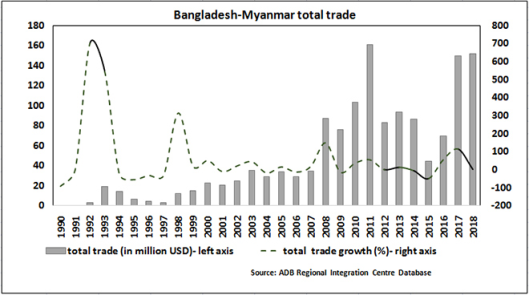
Bangladesh and Myanmar established a Border Trade arrangement in 1996. However, direct bilateral trade between the two countries was established in January 2012, enabling them to open letters of credit (LCs) with each other. Before this, trade was conducted indirectly through Singapore or Thailand . Moreover, in 2018, the two countries prioritized trade and investment promotion, along with the development of border infrastructure, when they decided to establish a joint task force. According to Myanmar’s Ministry of Commerce, bilateral trade between Bangladesh and Myanmar reached US$112.5 million in 2020. Bangladesh imports a variety of goods from Myanmar, including food items, agricultural products, and consumer goods. As a result, the trade balance heavily favors Myanmar.
Created by Roshan Saha, Research Assistant, ORF (Observer Research Foundation)

Download: Download full-size image

Figure 1. Bangladesh-Myanmar Total Trade.
Over the past 25 years, bilateral trade between Bangladesh and Myanmar has experienced significant growth. Bangladesh's exports to Myanmar increased from $4.02 million in 1995 to $48.4 million in 2020, growing at an annual rate of 10.5%. Similarly, Myanmar's exports to Bangladesh rose from $23.6 million in 1995 to $64.1 million in 2020, reflecting an annual growth rate of 4.07% . Looking to future trade it should be noted that, Myanmar and Bangladesh occupy a strategic location between the two largest global economies, India and China.
5. Causes of Security Threats to Bangladesh from the Myanmar Border
Bangladesh shares land borders with India to the west, north, and east, and with Myanmar to the southeast, while the Bay of Bengal lies to its south. The Bangladesh-Myanmar border, though much shorter in length at 271 kilometers compared to the extensive 4,096 kilometers shared with India, presents a unique set of security challenges that often receive less attention from the Bangladeshi government and security forces. Despite its smaller size, this border has become a focal point for both traditional and non-traditional security issues. Myanmar's internal conflicts, particularly involving ethnic armed groups and the military junta, have led to cross-border tensions, with insurgents and refugees frequently spilling into Bangladesh, exacerbating security concerns. The influx of displaced people, including the Rohingya crisis, has posed serious humanitarian and security risks, creating complex challenges for Bangladesh’s border management.
Additionally, the porous nature of the border and the presence of various militant groups, some with transnational links, have increased the risk of extremism, illegal trafficking, and organized crime. These non-traditional security threats, combined with the unpredictable political situation in Myanmar, often place the Bangladesh-Myanmar border in a more volatile position than the relatively stable India-Bangladesh border. Several prominent security threats are discussed in detail below.
5.1. Rohingya Refugee Influx
The Rohingya influx presents a significant security threat not only to Bangladesh but also to the broader South Asian region. The Myanmar military government claims that the Rohingyas are not indigenous to Myanmar and instead migrated from Bangladesh. However, historical evidence suggests otherwise; even before 1962, Rohingyas possessed government-issued identity cards and British-issued ration cards, confirming their status as citizens of Myanmar . Despite this, the Myanmar government refuses to recognize the Rohingya people as citizens . The majority of Rohingyas practice Islam and have limited access to modern education, leading many to seek refuge in Bangladesh. Myanmar’s troubling human rights record, characterized by the suppression and deprivation of minority communities, has only exacerbated the crisis.
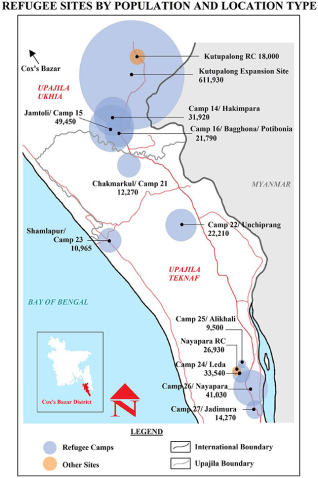
In August 2017, the Myanmar military launched a large-scale violent campaign against the Rohingya population in Rakhine State, resulting in the deaths of at least 6,700 people. Under humanitarian considerations and international pressure, Bangladesh initially opened its borders to the Rohingya refugees, allowing them entry. Currently, Bangladesh hosts over one million Rohingyas in 34 refugee camps, mostly situated along the Bangladesh-Myanmar border. Between November 2023 and December 2024, approximately 64,718 people from 17,500 Rohingya families fled to Bangladesh, as reported by the government’s Refugee, Relief, and Repatriation Office . However, diplomatic efforts to resolve the crisis have been met with resistance from Myanmar. Notably, in the past seven years, not a single Rohingya has been successfully repatriated.
The Rohingya influx has also led to several socio-economic challenges, particularly in the Bangladesh-Myanmar border region and, to some extent, across the entire country. Many Rohingyas have become involved in various criminal activities, including forging documents and other unlawful practices. Several national and international organizations have raised concerns about the security risks associated with the Rohingyas in Bangladesh. Crime and smuggling have become prevalent in Ukhiya and Teknaf, located in the Cox’s Bazar district. Bangladeshi security forces have uncovered numerous links between Rohingya refugees and illegal activities such as drug trafficking, human trafficking, murder, robbery, and armed conflicts, particularly in the border areas . These issues pose serious security threats and contribute to political instability not only in Bangladesh but also across the South Asian and Southeast Asian regions. Additionally, the influx has had severe environmental consequences, threatening local livelihoods, irrigation systems, and forests. Addressing these security concerns should be a priority for the Bangladesh government.
Figure 2. Refugee Sites by Population and Location Type.
Source: “Situation Report Rohingya Refugee Crisis, Cox’s Bazar”, Inter-Sector Coordination Group (ISCG), January 2019.
Moreover, Cox’s Bazar, the most popular tourist destination in Bangladesh, has been negatively affected by the Rohingya crisis. Tourists no longer feel as safe as before, and the free movement of Rohingyas on the beaches has raised concerns. Law enforcement agencies have detained Rohingya individuals, including women and children, from beach areas . The demographic landscape of Teknaf and Ukhiya sub-districts has also changed significantly, leading to increased air pollution and the spread of related diseases. The Kutupalong refugee camp has become the most densely populated refugee settlement in the world.
The Rohingya influx has also created economic hardships for the local population. Many poor locals in Cox’s Bazar have lost their jobs as Rohingya migrants are willing to work for lower wages. Additionally, the area faces risks associated with infectious diseases, human trafficking for sex and drugs, and rising commodity prices in local markets . Given these challenges, the Bangladesh government must take decisive measures to address the security, economic, and social issues arising from the Rohingya crisis.
5.2. Ethnic Militant Activity in the Bangladesh-Myanmar border
The wave of ethnic conflicts in Myanmar, particularly those occurring in the border regions, has become a major security concern for Bangladesh. However, Myanmar is home to over a hundred ethnic groups. Several ethnic insurgent groups are active along the Bangladesh-Myanmar border. Ethnic conflict in Myanmar is not a new issue; even before independence, ethnic groups were actively advocating for their demands. During the Second World War, ethnic minorities such as the Karens, Shans, Kachins, and Chins aligned with the British against the Japanese, while the Burmese majority supported Japan. This wartime divide further deepened ethnic distinctions, prompting the minorities to renew their demand for separate provinces, as previously promised by the British .
Ethnic militant activities in Myanmar have seen a significant surge in recent times, leading to a highly volatile situation. In February 2024, Bangladeshi newspapers reported that intense clashes between Myanmar’s military forces and armed insurgents had been ongoing along the Naikhongchhari border for at least a month. Stray bullets and mortar shells frequently landed in the border region, resulting in the deaths of at least two people and injuries to several others on the Bangladesh side. Due to security concerns arising from the conflict, Bangladeshi authorities canceled the use of Ghumdhum High School in Bandarban's Naikhongchhari border area as an examination center for the Secondary School Certificate (SSC) exams . Due to violent clashes between the Arakan Army (AA) and Myanmar's military junta, a total of 330 government personnel—including Border Guard Police, army soldiers, and immigration officials—fled to Bangladesh. However, Bangladesh sent them back to their country by ship in April 2024, more than a week after their arrival .
Experts have expressed concerns that the intensifying conflict could potentially result in the emergence of a new country, particularly in the border region between Bangladesh and Myanmar. In mid-December 2024, numerous international media outlets reported that the AA had seized the final military outpost in the strategically significant western town of Maungdaw, securing complete control over the territory along the Bangladesh-Myanmar border. The current situation has instilled fear among residents near the Bangladesh-Myanmar border, bringing cross-border trade to a standstill. Both locals and Rohingya refugees in Cox’s Bazar are alarmed by reports of the AA's takeover of Rakhine State, which includes full control of the 270 km border with Bangladesh . Bangladeshi citizens living near the Myanmar border reported hearing the sounds of gunfire and battles from across the border almost daily throughout December 2024 .
The ongoing ethnic conflict between the AA and Myanmar's Junta Army has significantly impacted Bangladesh, particularly in terms of food supply and passenger transport to St. Martin's Island, a popular tourist destination for Bangladeshis. Occasionally, Myanmar's military mistakenly fires into Bangladeshi territory, targeting border guards and locals transporting supplies to the island. In response to these incidents, Bangladesh's former Home Minister, Asaduzzaman Khan, warned the Myanmar military that Bangladesh would be compelled to retaliate if such actions persisted .
5.3. Terrorist Activity on the Border
Border crossing by the people of both countries is very common . In this case, terrorists from Myanmar may potentially enter Bangladesh. Mainly two Rohingya militant groups operate in the border region: the Arakan Rohingya Salvation Army (ARSA) and the Rohingya Solidarity Organization (RSO). ARSA and RSO share a rival relationship and occasionally clash with each other. The ongoing contestation among ARSA, RSO, and other smaller groups is likely to contribute to continued insecurity in Bangladesh.
ARSA was accused of killing nearly half a dozen security personnel in Myanmar's Rakhine State in 2017. This organization, active along the Bangladesh-Myanmar border, poses a potential threat to Bangladesh as well. ARSA first gained prominence in 2017 near the border in Rakhine. Bangladesh’s security agencies are concerned that the group may attempt to recruit members from within the refugee camps in Bangladesh and use these camps as a base for cross-border operations . In November 2022, an officer of the Directorate General of Forces Intelligence (DGFI) was reportedly killed by the ARSA during an operation in No Man’s Land—an informal Rohingya camp situated between the border fences of Bangladesh and Myanmar, where ARSA was known to operate .
The ongoing ethnic conflict in Myanmar's Rakhine State between the AA and the junta has raised significant concerns, particularly due to the AA's claims that the ARSA is supporting the junta. If this claim holds, it implies that ARSA may have access to heavy weaponry supplied by the Myanmar military. This development is alarming for Bangladesh, as ARSA is known to be active along the Bangladesh-Myanmar border. There is a genuine risk that these weapons could be smuggled into Bangladesh by ARSA, posing a serious security threat .
5.4. The Influx of Illegal Small and Heavy Arms
For many years, the Myanmar-Bangladesh border has been a hotspot for illegal arms trafficking, with security forces seizing shipments almost annually. Many insurgent groups in Myanmar finance their operations through the illegal drug trade. Some of these groups are strong enough to challenge the state and sustain prolonged armed resistance . However, Myanmar has functioned as a transit hub for small arms, supplying insurgent groups in Bangladesh's Chittagong Hill Tracts and India's northeastern states. Moreover, The Chittagong Hill Tracts of Bangladesh, home to several ethnic insurgent groups, have been a primary destination for illegal arms trafficked through the Myanmar route.
Illegal heavy weapons are entering Bangladesh through the Myanmar border, fueling separatist activities among groups based in the Rohingya camps in Ukhiya and Teknaf. In a major operation in May 2024, law enforcement authorities seized a large cache of military-grade weapons and ammunition from these camps. The Rapid Action Battalion (RAB) conducted a raid on a hideout linked to Myanmar’s armed group, the ARSA, in the remote Lal Pahar area of Ukhiya. Following a gunfight with ARSA’s Bangladesh commander, Master Salimullah, RAB recovered an array of arms, including five grenades, three rifle grenades, ten improvised hand grenades, thirteen explosive devices, a foreign revolver, one LG firearm, and a significant quantity of ammunition and cartridges.
In the same month, RAB conducted another operation, apprehending arms dealers involved in smuggling sophisticated weapons from Myanmar into the Rohingya refugee camps. The confiscated arsenal included foreign-made weapons such as German-manufactured G3 rifles and rocket cells. The majority of the seized arms were of international origin, underscoring the severity of the smuggling network operating across the border. An officer from the BGB stated to Dhaka Tribune, "The illegal shipment of heavy weapons into the country is being orchestrated by a well-organized international smuggling network. These groups are responsible for transporting arms consignments across the border. The network's influence may even extend to individuals tasked with border security, making it exceedingly challenging to dismantle ."
5.5. Illegal Fishing and Bangladeshi Fisherman Security
Illegal fishing poses a significant threat to both Bangladesh's security and the safety of its fishermen. Over the years, there have been several incidents involving fishermen from Myanmar allegedly crossing the boundary illegally on the Naf River. In a gesture of good neighborliness, the Bangladesh government pardoned 92 Myanmar fishermen in August 2016 after they had been apprehended for illegally entering Bangladesh's territorial waters in December 2015. According to the Bangladesh Embassy in Yangon, the fishermen were caught by Bangladeshi authorities after crossing into Bangladesh’s waters aboard 12 fishing boats. The relevant authorities in Myanmar were promptly notified of the incident. In June 2016, Bangladesh received a formal request from Myanmar seeking clemency for the detained fishermen. Upholding the spirit of good neighborly relations and in accordance with the Border Arrangement of 1980 between the two nations, the Bangladesh government expedited the clemency process, leading to their release .
Foreign fishermen from Myanmar frequently intrude into Bangladesh's maritime territory, equipped with modern fishing gear. This poses a significant challenge for the fishermen of St. Martin’s Island, who lack advanced equipment and struggle to compete. Notably, when the Bangladesh Coast Guard (BCG) apprehends these foreign fishing trawlers, the fishermen often claim refugee status to evade imprisonment . In November 2019, the BCG detained 16 Myanmar fishermen and seized two trawlers for illegally entering Bangladesh's maritime territory to fish in the Bay of Bengal. The fishermen were intercepted 25 kilometers south of Saint Martin’s Island .
On the other hand, media reports indicate that assaults by Myanmar security forces on Bangladeshi fishing boats and fishermen in the maritime border area have been relatively common since at least the mid-1990s . In December 2016, the Myanmar Navy fired upon a Bangladeshi fishing trawler in the Bay of Bengal near St. Martin’s Island, Cox’s Bazar, injuring between four and six fishermen . Moreover, In February 2017, a Burmese patrol boat opened fire on Bangladeshi fishermen in the Naf River, resulting in the death of one fisherman. Since then, numerous similar incidents have occurred. Recently, In November 2024, Frontier reported an incident involving six Bangladeshi fishing boats near the maritime boundary in the Bay of Bengal. As they operated in the area, a Myanmar warship appeared, prompting the fishermen to retreat out of fear. However, before they could escape, a black speedboat approached, and two armed men opened fire without warning, killing one fisherman and injuring two others. Moments later, Myanmar navy personnel—identifiable by their Burmese language and uniforms—boarded the boats, restrained the fishermen, and tethered them to a warship. The fishermen remained detained for an entire day before being released without explanation . This report provides a clear understanding of the terror situation faced by Bangladeshi fishermen along the maritime boundary with Myanmar.
Due to the ongoing conflict in Rakhine State, Bangladeshi fishermen who navigate the Naf River and maritime border areas to catch fish are facing significant threats. The Bangladesh government has instructed them to avoid these regions for their safety . In 2024, multiple incidents occurred where Bangladeshi fishermen were captured by the AA. In October of that year, a Bangladeshi fisherman was fatally shot by a bullet fired from Myanmar. In the same month, five Bangladeshi fishermen were released from AA detention after being accused of illegally entering Arakan territory. In another incident in November 2024, the AA detained 20 Bangladeshi fishermen but released them to the BGB after three days. In both incidents, the Bangladesh government's response did not fully satisfy the local people. As a result, they remain in fear and have refrained from regular fishing operations. However, several newspapers reported multiple incidents of Bangladeshi fishermen being detained by AA until February 2025.
5.6. Maritime Boundary Issue
Myanmar's continued provocations against Bangladesh over maritime boundary issues have escalated into a serious national concern, potentially posing a significant threat along the maritime border. However, on 14th March 2012, Humburg- based Law of the Sea Tribunal (ITLOS) delivered a historical verdict about the Bangladesh-Myanmar long-standing maritime boundary demarcation dispute. This judgment can marked as the distinctive legal success of Bangladesh. After that, Bangladesh and Myanmar never faced any conflicts regarding maritime boundary issues. In October 2018, tensions resurfaced when Myanmar updated its official map on the Department of Population's website, as well as on another site, displaying St Martin’s Island as part of its territory . The Bangladesh authorities have stated that there is an "ulterior motive" behind the creation and circulation of Myanmar's map on websites. Because, even when Bangladesh won the maritime boundary dispute against Myanmar through ITLOS, it was explicitly stated that the island belonged to Bangladesh.
In response, the Bangladesh government summoned Myanmar's Ambassador U Lwin Oo to explain the depiction of St. Martin's Island, located in the Bay of Bengal, as part of Myanmar on two of its government websites. The Myanmar ambassador has acknowledged the mistake and apologized for the misrepresentation. However, the color of Bangladesh’s island territory and Myanmar's Rakhine state on the map remained the same as that of the country. Interestingly, in February 2019, a map on a Myanmar government website once again falsely depicted the same island as part of its territory. When the Bangladeshi authorities raised the issue with the Myanmar embassy in Dhaka, the embassy acknowledged the mistake. This indicated that the neighboring nation had not abandoned its attempt to claim St. Martin’s Island as its own.
Additionally, it should be mentioned that St. Martin's Island, a small landmass covering nine square kilometers in the northeastern part of the Bay of Bengal, has been a part of Bangladesh since its independence in 1971. Home to approximately 10,000 residents, the island relies primarily on fishing and tourism as sources of livelihood. Renowned for its natural beauty, St. Martin’s Island is a popular tourist destination.
5.7. Illicit Drug Trafficking
The smuggling of illegal drugs into Bangladesh through the Myanmar border is not a new phenomenon. Bangladesh's Department of Narcotics Control (DNC) has highlighted the Myanmar border as a key entry point for illegal drugs . This is because Myanmar is the world's second-largest producer of opium and a rapidly growing hub for Amphetamine-Type Stimulant (ATS) production . Moreover, Myanmar is a central player in the Golden Triangle, alongside Thailand and Laos, and Bangladesh is primarily used as a transit route for drug smuggling. The country has made significant arrests and dismantled several drug trafficking networks. In Bangladesh-Myanmar border areas a large number of drug smugglers are actively involved in the yaba trade.
The DNC has been seizing an increasing number of yaba consignments each year. In 2006, only 1,687 pills were confiscated, but this number surged to over 36,000 by 2008 and exceeded eight lakh in 2010. This provided narcotics officials with a rough estimate of the extent of yaba's prevalence, as it is believed that only 10 percent of the drug is seized while the remaining 90 percent circulates in the market—a staggering amount . Many Rohingyas, along with residents, are involved in the Yaba trade. Nearly 92% of Yaba pills are trafficked by Rohingyas, with over 96% of the supply entering Bangladesh through the Teknaf route .
Since 2022, Myanmar has been engulfed in a widespread and intense civil war across various states. The prolonged civil war in Myanmar has turned Shan State into a major hub for illicit drug production, posing a significant threat to neighboring Bangladesh. According to the DNC, large shipments of Yaba, crystal meth (ice), and heroin are flowing into Bangladesh, with Shan State as the primary source. The United Nations Office on Drugs and Crime (UNODC) reports that Myanmar has become the world's leading producer of opium (2024), with nearly fifty factories in Shan State manufacturing synthetic drugs like Yaba and ice. Border areas like Teknaf and Naikhong have witnessed significant drug seizures, highlighting the growing challenge for Bangladeshi law enforcement. The region's drug trade is fueled by easy access to raw materials from the Golden Triangle, exacerbating the crisis amid Myanmar’s political turmoil . However, the AA has accused the Myanmar military junta of being involved in drug trafficking, allegedly in collaboration with the ARSA and the Arakan Rohingya Army (ARA), to smuggle drugs into Bangladesh. In response, the AA has called on neighboring countries to heighten their vigilance against these activities. Meanwhile, a junta spokesperson, through military-affiliated newspapers, has countered the allegations by labeling the AA itself as a drug-trafficking organization . Additionally, since the arrival of the Rohingya in 2017, the local market for yaba and crystal meth has expanded .
In April 2023, Bangladeshi authorities announced the seizure of 21.09 kilograms (46 pounds) of crystal meth, locally known as "ice," valued at 10 million Bangladeshi taka—marking the largest drug bust in the country's history. Speaking at a press conference in Cox's Bazar, the BGB reported the arrest of a drug ring leader and two of his associates during an early-morning anti-narcotics operation near the border with Myanmar. In the same month, the BGB also confiscated 410,000 pink Yaba pills and other drugs in two separate operations along the Naf River, which forms part of the border with Myanmar . Moreover, in 2020, the DNC confiscated 210 kilograms of heroin, which surged to over 700 kilograms by 2023. Within the first half of 2024 alone, authorities seized more than 357 kilograms of heroin .
Additionally, the recent (February 2025) lifting of the eight-year fishing ban on the Naf River by the Bangladesh government may lead to an increase in drug trafficking in the near future. The ban, which was implemented in 2017 due to the Rohingya influx, had restricted fishing activities. Under the new regulations, fishermen are now allowed to resume fishing, although they are prohibited from fishing between 4 PM and 8 AM. The Naf River is a major trade route for illicit activities, including drug trafficking, and the lifting of the ban could potentially exacerbate these issues.
5.8. Absence of Democracy in Myanmar
The absence of democracy in Myanmar poses a significant threat to Bangladesh, particularly in the border region, as it prevents Myanmar from ensuring good governance and adequate facilities for its citizens. The absence of democracy undermines a country's system by enabling authoritarian rule, suppressing individual freedoms, and eroding accountability and justice. Such conditions often have ripple effects on neighboring countries. However, Myanmar, like many others in the region, endured prolonged British colonial rule before gaining independence in 1948. Upon independence, the nation adopted a parliamentary democracy, forming the Union of Burma, similar to its newly independent neighbors in South Asia. Unfortunately, this democratic era was short-lived, lasting only 14 years until 1962, when General Ne Win orchestrated a military coup. This marked the beginning of decades of military dominance, interrupted only by a quasi-democratic period initiated in 2011 through military-backed reforms. Unfortunately, this era of partial democracy came to an abrupt end in 2021 with the return of authoritarian military rule.
In its history, Myanmar has experienced roughly 24 years of democratic or semi-democratic governance, overshadowed by about 40 years of authoritarian military rule. This prolonged military dominance has significantly hindered the establishment of a strong governance framework. Since the military takeover in 2021, the country has entirely lost its democratic footing, and the prospects for its return remain uncertain. The absence of democracy has triggered widespread public protests against the junta government. In response, the regime has brutally suppressed dissent, forcing many citizens to flee to neighboring countries for safety. According to the Assistance Association for Political Prisoners, at least 6,106 civilians have been killed by security forces since the 2021 coup, excluding those killed in the ongoing conflict . In this context, Bangladesh faces potential challenges from an influx of illegal migrants, raising concerns about national security and stability. This is because the remaining 400,000 Rohingya in Myanmar may attempt to enter Bangladesh.
5.9. Killings of Bangladeshis by Myanmar's Military and Paramilitary Forces
For years, Bangladeshi citizens—particularly those living along the border—have faced violence at the hands of Myanmar’s security forces. These incidents include killings, kidnappings, and beatings, creating a long-standing humanitarian and security concern between the two neighboring countries. Looking back to history, in 1991, relations between Bangladesh and Myanmar took a hostile turn when Myanmar's forces launched an attack on the Rejupara Border Outpost (BOP). The assault resulted in the deaths of three members of the Bangladesh Rifles (BDR), and Myanmar troops looted all the arms and ammunition from the post. In response, Bangladesh heightened its military alert, bringing both nations to the brink of conflict. Tensions escalated rapidly, with war seemingly imminent. However, a full-scale regional clash was narrowly avoided through diplomatic efforts by the newly elected government of Bangladesh .
Since then, the relationship has remained turbulent. In the following decades, Myanmar forces have carried out multiple attacks on Bangladeshi civilians. Between 7 October 1998 and 20 August 2000, a series of violent incidents occurred near St. Martin’s Island, where Bangladeshi fishermen were targeted by Burmese naval and border forces, leading to multiple fatalities and diplomatic tensions between the two neighboring countries. The first documented incident took place on 7 October 1998, when Burmese Navy forces opened fire on a group of Bangladeshi fishermen operating just off the coast of St. Martin's Island. Reports indicate that between three and five fishermen were killed in the attack. The aggressive action caused fear and uncertainty among the local fishing community, which relies on these waters for their livelihood.
Less than a year later, on 8 September 1999, another deadly encounter took place. A Bangladeshi fishing boat, navigating near St. Martin’s Island, came under fire from Burmese naval forces . One fisherman was killed, while the remaining nine crew members abandoned the vessel and swam desperately towards safety. Fortunately, they were rescued by Bangladeshi authorities. In response to this attack, the Bangladeshi government lodged a formal diplomatic protest with Myanmar, condemning the use of lethal force against its unarmed civilians. Despite these diplomatic efforts, another violent confrontation occurred on 20 August 2000. This time, Bangladeshi police reported that Burmese border guards had shot and killed four more Bangladeshi fishermen in the waters off St. Martin’s Island. This latest attack further exacerbated tensions between Bangladesh and Myanmar, fueling concerns over the safety of Bangladeshi fishermen and the security of maritime boundaries in the region. A comparable attack occurred in December 2016 when the Bangladeshi border guard accused the Myanmar Navy of opening fire on four Bangladeshi fishermen in the Bay of Bengal.
Ongoing clashes between Myanmar's military and rebel groups frequently spill over into Bangladeshi territory, with stray bullets and artillery shells striking border areas. These incursions create fear among residents and endanger innocent lives. Myanmar's deployment of landmines along the border endangers refugees and locals, with frequent injuries and fatalities, especially among children. Violations by Myanmar troops, including attacks on Bangladeshi security forces, abductions, and property theft, have escalated tensions and strained bilateral relations . In February 2024, Bangladeshi media reported that shelling from Myanmar struck a house in Bandarban, resulting in the deaths of at least two individuals, including a Bangladeshi woman and a Rohingya refugee . In October, A Bangladeshi teenager sustained injuries in a mine explosion at Lalchar, near the Naf River along the Myanmar border. The victim, Omar Faruk, 18, from Hwaikyang in Teknaf upazila of Cox’s Bazar, was reportedly injured after crossing into Myanmar to collect fruit .
The killings, kidnappings, and assaults of Bangladeshi citizens by Myanmar’s security forces remain a pressing issue, demanding stronger diplomatic engagement and regional cooperation. Without concrete measures, such actions threaten not only the security of border communities but also the broader stability of Bangladesh-Myanmar relations.
5.10. Human Trafficking
Human trafficking has become a significant concern along the Bangladesh-Myanmar border, with Rohingya refugees being particularly vulnerable to exploitation. Faced with dire living conditions and limited opportunities, many fall prey to well-organized criminal networks that operate across national borders. These traffickers, often posing as recruiters or aid providers, lure desperate individuals—especially women and children—into deceptive schemes that lead to forced labor, sexual exploitation, and other forms of abuse .
Security experts warn that these trafficking operations are not isolated crimes but part of sophisticated transnational networks. Reports indicate that certain elements within Myanmar’s border security forces may be complicit in these activities, actively coercing Rohingya refugees onto smuggler boats under the pretense of relocation or safety. Once trafficked, victims face extreme hardships, often enduring physical abuse and inhumane conditions while being transported to distant locations. The worsening human trafficking situation exacerbates the already dire refugee crisis, further destabilizing the region. The illegal movement of people across borders fuels broader security concerns, including organized crime and regional unrest.
6. Recommendation
In this context, several recommendations can be proposed for Bangladesh authority to enhance border security with Myanmar. Given that Myanmar serves as a potential gateway for an alternative land route connecting Bangladesh to China and Southeast Asia—bypassing maritime routes—establishing a secure and well-regulated border is crucial. Such a road link holds significant potential for strengthening communication networks and fostering greater connectivity between Bangladesh and Southeast Asian nations.
Firstly, Bangladesh-Myanmar joint security cooperation has proven to be a crucial mechanism for addressing border-related security threats and combating terrorism. Periodic meetings between border security forces, such as Bangladesh’s BGB and Myanmar’s BGP, have facilitated better coordination in tackling cross-border militancy. Additionally, their engagement in regional security forums like Bay of Bengal Initiative for Multi-Sectoral Technical and Economic Cooperation (BIMSTEC) and Association of Southeast Asian Nations (ASEAN) has further reinforced efforts to curb extremism and enhance stability in the region.
Secondly, Bangladesh, in collaboration with India, could play a key role in facilitating a ceasefire between the Myanmar junta and the rebel groups operating along their shared border. A ceasefire, brokered by China in January 2025, was already established between the Myanmar National Democratic Alliance Army (MNDAA) in the Kokang region of northern Shan State . This successful intervention could serve as an inspiration for Bangladesh to take similar diplomatic steps.
Thirdly, to effectively combat drug trafficking issues, both countries must enhance bilateral cooperation through intelligence sharing, joint border patrols, and stricter law enforcement measures. Strengthening regional frameworks, such as ASEAN and South Asian Association for Regional Cooperation (SAARC) initiatives, and engaging in diplomatic dialogues can further reinforce efforts to dismantle drug networks. Additionally, promoting economic development and alternative livelihood opportunities in vulnerable border communities can help curb the root causes of drug production and trafficking. A collaborative approach between Bangladesh and Myanmar is crucial not only for safeguarding their national security but also for ensuring broader regional stability.
Fourthly, Bangladesh, with international support, should address camp security, focusing on Rohingya armed groups. Most Rohingya reject these groups as illegitimate and harmful. Their activities disrupt humanitarian aid and hinder Rohingya civil society, which could aid Bangladesh in repatriation efforts.
Fifthly, Bangladesh and international actors should engage with the AA politically, even if discreetly, as it nears full control of the Bangladesh-Myanmar border. Despite mutual mistrust, constructive engagement is essential. The AA must signal positive intentions toward the Rohingya, while Bangladesh should ensure that Rohingya armed groups cannot operate within its borders.
Sixthly, strengthening the narcotics control department is essential to combating the influx of drugs. The Narcotics Department in Bangladesh faces a significant challenge due to a shortage of manpower. With only 3059 personnel, the department struggles to combat the widespread trafficking and abuse of yaba and other drugs . This limited workforce is inadequate to effectively control the influx of narcotics into the country. To address this issue, the Bangladesh government, in coordination with the BGB, could consider establishing a specialized Narcotics Control Police. Expanding the department with dedicated law enforcement personnel would enhance its ability to curb drug trafficking, strengthen border surveillance, and ensure more effective enforcement of narcotics laws.
7. Conclusion
Since the inception of diplomatic relations, Bangladesh has consistently pursued a friendly and cooperative approach toward Myanmar. However, Myanmar, much like its approach to a few other neighboring states, has largely maintained a distant and indifferent stance toward Bangladesh. The military-led governments in Myanmar have historically failed to acknowledge or address the security threats emanating from the border areas, which have significantly impacted Bangladesh. In many instances, state-sponsored activities from Myanmar have exacerbated existing tensions, further complicating bilateral relations. One of the most pressing security concerns for Bangladesh has been the Rohingya crisis, which has placed immense social, economic, and security burdens on the country. The influx of Rohingya refugees, fleeing persecution and violence in Myanmar, has led to humanitarian challenges and regional instability.
Additionally, the porous border has facilitated illegal drug trafficking, arms smuggling, and other transnational crimes, contributing to the rise of non-traditional security threats. The presence of powerful non-state actors operating near the border has only added to these challenges, making Bangladesh vulnerable to both internal and external security risks. Given the complex and multifaceted nature of the security threats posed by Myanmar, Bangladesh must adopt a dual-track approach to managing its relations with its neighbors.
On the diplomatic front, Bangladesh should continue to engage Myanmar through peaceful negotiations and multilateral platforms, seeking support from regional stakeholders such as ASEAN, SAARC, BIMSTEC, and international organizations. Diplomatic pressure, coupled with strategic alliances, can help Bangladesh push for constructive resolutions to the ongoing issues. At the same time, Bangladesh must adopt a firm and pragmatic policy with a zero-tolerance stance on security threats. This includes strengthening border security, enhancing intelligence-sharing mechanisms, and implementing stringent measures to combat drug and arms trafficking. A combination of soft and hard power strategies will enable Bangladesh to safeguard its national security interests while maintaining regional stability. If Bangladesh fails to address its security threats, particularly in the identified border areas, its economic growth and regional peace-building initiatives will be severely impacted.
Abbreviations

AA

Arakan Army

ARA

Arakan Rohingya Army

ARSA

Arakan Rohingya Salvation Army

ASEAN

Association of Southeast Asian Nations

BCG

Bangladesh Coast Guard

BDR

Bangladesh Rifles

BGB

Border Guard Bangladesh

BIMSTEC

Bay of Bengal Initiative for Multi-Sectoral Technical and Economic Cooperation

BOP

Border Outpost

DGFI

Directorate General of Forces Intelligence

DNC

Department of Narcotics Control

IMF

International Monetary Fund

ISCG

Inter-Sector Coordination Group

ITLOS

International Tribunal for the Law of the Sea

MNDAA

Myanmar National Democratic Alliance Army

RAB

Rapid Action Battalion

RSO

Rohingya Solidarity Organisation

SAARC

South Asian Association for Regional Cooperation

SSC

Secondary School Certificate

UNODC

United Nations Office on Drugs and Crime

Author Contributions
The main author conceptualized the research idea, designed the methodology, and conducted the all data collection and analysis. He is responsible for drafting the initial manuscript, interpreting the findings, and integrating feedback from co-authors. Additionally, the main author coordinated the overall research process, ensuring consistency and academic rigor throughout the development of the article.
Conflicts of Interest
The authors declare no conflicts of interest.
References
[1] Bangladesh has potential to become $800bn economy by 2030: Experts, United News of Bangladesh, June 23, 20201,
[2] Sharmily, Syeda. (2023). Building the Future of Bangladesh-Myanmar Economic Prosperity. Australian Institute of International Affairs. Available:
[3] Bangladesh-Myanmar trade and investment: Opportunities and way forward. The Business Standard. Available:
[4] Syeda Naushin Parnini (2013) The Crisis of the Rohingya as a Muslim Minority in Myanmar and Bilateral Relations with Bangladesh, Journal of Muslim Minority Affairs, 33: 2, 281-297,
[5] Sohel MS. The Rohingya crisis in Myanmar: Origin and emergence. Saudi Journal of Humanities and Social Sciences. 2017; 2(11): 1002-1018.
[6] Sounds of explosions at Myanmar border spark fears of new Rohingya influx. Dhaka Tribune. Available:
[7] Hossain, Md. Rohingya Refugee Crisis: Security Concerns for Bangladesh. South Asian Journal of Social Studies and Economics.
[8] Police detain 453 Rohingya visitors from refugee camps on Cox’s Bazar beach. bdnews24.com. Available:
[9] Alam, M. (2018). How the Rohingya crisis is affecting Bangladesh, and why it matters, An Analysis by Monkey Cage. The Washington Post. Available:
[10] Mathew J. Walton. ‘Ethnicity, Conflict and History in Burma’, Asian Survey, XLVIII(6), November /December 2008, pp. 892–895.
[11] Examinees shifted from Ghumdhum SSC test centre amid Myanmar war. Bdnews 24.com. Available:
[12] Bangladesh repatriates Myanmar troops after fighting on border. The Hindu. Available:
[13] Tension, fear in Teknaf as Myanmar’s Arakan Army claims taking control of border with Bangladesh. Asia News Network. Available:
[14] Bangladesh boosts border security as Arakan Army claims control of Myanmar’s Rakhine. Arab News. Available:
[15] Bangladesh warns to counterfire if cross-border shooting from Myanmar doesn't stop. Anadolu Ajansı. Available:
[16] Uddin, M. K. & Ahamed, A. (May, 2011). Bangladesh-Myanmar relations: continuity and change, The Chittagong University Journal of Social Sciences, Vol. 26, pp. 79-98.
[17] United Nations High Commission for Refugees. Operational update: Bangladesh; 2018. Available:
[18] Competing armed groups pose new threat to Rohingya in Bangladesh. IISS. Available:
[19] Ethnic Armed Group Claims Full Control of Myanmar’s Border Wih Bangladesh. The Diplomat. Available:
[20] Anshuman Behera. (2017). Insurgency, Drugs and Small Arms in Myanmar, Strategic Analysis, 41: 1, 34-48,
[21] Illegal heavy weapons entering Bangladesh from Myanmar. Dhaka Tribune. Available:
[22] Bangladesh frees 92 Myanmar fishermen. The Daily Star. Available:
[23] Miah, M. R., Islam, M. M. (2020). Defending fishing space: Conflictsand marginalization of small-scale fisheries in the Saint Martin's Islandof Bangladesh. In: Kerezi, V., Pietruszka, D. K., & Chuenpagdee, R. (Eds.) Blue Justice For Small-Scale Fisheries: A Global Scan. TBTIGlobal Publication Series, St. John's, NL, Canada.
[24] 16 Myanmar fishermen held from the Bay. The Daily Star. Available:
[25] Safety of fishermen in the Bay of Bengal. The Financial Express. Available on:
[26] Bangladesh protests Myanmar navy’s firing on fishermen. The Daily Sun. Available:
[27] Troubled waters: Bangladeshi fishermen rocked by Rakhine war. Frontier. Available:
[28] Teknaf fishermen warned as tensions escalate in Myanmar border. Dhaka Tribune. Available:
[29] Myanmar's Claim to St. Martin's Island Irks Bangladesh. The Wire. Available:
[30] Drug being smuggled into country through 146 unprotected border points. The Daily Prothom Alo. Available on:
[31] World Drug Report 2014. United Nations Office on Drugs and Crime, New York. 2014. p. 73.
[32] Yaba invasion -1: Hostage to Myanmar. Inam Ahmed. The Daily Star. Available:
[33] ‘I carry yaba to survive’: Rohingya and Bangladesh’s meth trade. Aljazeera. Available:
[34] Myanmar’s drug empire poses growing threat to Bangladesh. Dhaka Tribune. Available:
[35] AA Accuses Junta and ARSA of Trafficking Narcotics to Bangladesh. Burma News International. Available:
[36] Myanmar army directly involved in trafficking yaba to Bangladesh: Prof Imtiaz. The Business Standard. Available:
[37] Bangladesh seizes drugs worth $10M in nation's biggest bust. Anadolu Ajansı. Available:
[38] Myanmar’s drug empire poses growing threat to Bangladesh. The Financial Express. Available:
[39] Military junta extends state of emergency in Myanmar for another 6 months. Anadolu Ajansı. Available:
[40] Obayedul Hoque Patwary. Bangladesh - Myanmar Relations: The Security Dimension. Bangladesh Institute of Peace and Security Studies.
[41] Reuters-Myanmar News. Thu, 09 Sep 1999. Available:
[42] Abu Ahmed Farid. Security concerns for Bangladesh. New Age. Available:
[43] For the first time, Myanmar forces flee into Bangladesh during fighting with an ethnic armed group. AP News. Available:
[44] Bangladeshi teen injured in mine explosion inside Myanmar territory. Dhaka Tribune. Available:
[45] Human trafficking ring active in Bandarban. Dhaka Tribune. Available on:
[46] Myanmar junta, rebels sign ceasefire deal, announces China. Anadolu Ajansı. Available:
[47] Department of Narcotics Control. Available:
Cite This Article
  • APA Style

    Raju, A. S., Chowdhury, F. S., Upama, S. W., Barmanhriday, K. C. (2025). Bangladesh-Myanmar Border: A Persistent Threat to Bangladesh’s National Security. Humanities and Social Sciences, 13(2), 187-198. https://doi.org/10.11648/j.hss.20251302.22

    Copy | Download

    ACS Style

    Raju, A. S.; Chowdhury, F. S.; Upama, S. W.; Barmanhriday, K. C. Bangladesh-Myanmar Border: A Persistent Threat to Bangladesh’s National Security. Humanit. Soc. Sci. 2025, 13(2), 187-198. doi: 10.11648/j.hss.20251302.22

    Copy | Download

    AMA Style

    Raju AS, Chowdhury FS, Upama SW, Barmanhriday KC. Bangladesh-Myanmar Border: A Persistent Threat to Bangladesh’s National Security. Humanit Soc Sci. 2025;13(2):187-198. doi: 10.11648/j.hss.20251302.22

    Copy | Download

  • @article{10.11648/j.hss.20251302.22,
      author = {Ataus Samad Raju and Fouzia Sultana Chowdhury and Sunjida Wadud Upama and Koushik Chandra Barmanhriday},
      title = {Bangladesh-Myanmar Border: A Persistent Threat to Bangladesh’s National Security
    },
      journal = {Humanities and Social Sciences},
      volume = {13},
      number = {2},
      pages = {187-198},
      doi = {10.11648/j.hss.20251302.22},
      url = {https://doi.org/10.11648/j.hss.20251302.22},
      eprint = {https://article.sciencepublishinggroup.com/pdf/10.11648.j.hss.20251302.22},
      abstract = {Over the past decade, Bangladesh has made significant strides in economic development, with forecasts indicating continued growth in the years ahead. However, sustaining this progress requires ensuring national security, which has become a top priority for the government. Geopolitically, Bangladesh and Myanmar serve as a critical bridge between South Asia and Southeast Asia. Despite having less direct border connectivity with Myanmar compared to India, Bangladesh faces a range of both conventional and non-conventional security threats along this frontier. Among the most pressing issues is the ongoing Rohingya crisis, which has evolved into a matter of global concern, as well as the persistent influx of illegal drugs trafficked from Myanmar into Bangladesh. Arms smuggling along the Bangladesh-Myanmar border is another longstanding threat that has remained unresolved over the years. Additionally, Myanmar's limited cooperation with Bangladesh—exacerbated by its prolonged absence of democratic governance—has further strained bilateral relations. Compounding these challenges is the continuing instability in Myanmar’s Rakhine State, where the Arakan Army's armed struggle against the junta government poses additional security risks for Bangladesh. This article will explore these key issues in depth, along with other related security concerns, by analyzing prominent incidents and developments. Finally, the article will present a set of recommendations aimed at strengthening Bangladesh’s border security and safeguarding national stability and economic prosperity.
    },
     year = {2025}
    }
    

    Copy | Download

  • TY  - JOUR
    T1  - Bangladesh-Myanmar Border: A Persistent Threat to Bangladesh’s National Security
    
    AU  - Ataus Samad Raju
    AU  - Fouzia Sultana Chowdhury
    AU  - Sunjida Wadud Upama
    AU  - Koushik Chandra Barmanhriday
    Y1  - 2025/04/29
    PY  - 2025
    N1  - https://doi.org/10.11648/j.hss.20251302.22
    DO  - 10.11648/j.hss.20251302.22
    T2  - Humanities and Social Sciences
    JF  - Humanities and Social Sciences
    JO  - Humanities and Social Sciences
    SP  - 187
    EP  - 198
    PB  - Science Publishing Group
    SN  - 2330-8184
    UR  - https://doi.org/10.11648/j.hss.20251302.22
    AB  - Over the past decade, Bangladesh has made significant strides in economic development, with forecasts indicating continued growth in the years ahead. However, sustaining this progress requires ensuring national security, which has become a top priority for the government. Geopolitically, Bangladesh and Myanmar serve as a critical bridge between South Asia and Southeast Asia. Despite having less direct border connectivity with Myanmar compared to India, Bangladesh faces a range of both conventional and non-conventional security threats along this frontier. Among the most pressing issues is the ongoing Rohingya crisis, which has evolved into a matter of global concern, as well as the persistent influx of illegal drugs trafficked from Myanmar into Bangladesh. Arms smuggling along the Bangladesh-Myanmar border is another longstanding threat that has remained unresolved over the years. Additionally, Myanmar's limited cooperation with Bangladesh—exacerbated by its prolonged absence of democratic governance—has further strained bilateral relations. Compounding these challenges is the continuing instability in Myanmar’s Rakhine State, where the Arakan Army's armed struggle against the junta government poses additional security risks for Bangladesh. This article will explore these key issues in depth, along with other related security concerns, by analyzing prominent incidents and developments. Finally, the article will present a set of recommendations aimed at strengthening Bangladesh’s border security and safeguarding national stability and economic prosperity.
    
    VL  - 13
    IS  - 2
    ER  - 

    Copy | Download

Author Information
  • Department of Natural Science, Port City International University, Chittagong, Bangladesh

  • Department of Natural Science, Port City International University, Chittagong, Bangladesh

  • Department of Natural Science, Port City International University, Chittagong, Bangladesh

  • Department of Natural Science, Port City International University, Chittagong, Bangladesh